Are Fuse Beads Safe? Material, Ironing Ventilation and Age Guide
Fuse beads have been sold as a children's craft toy for decades, and major brands test them against toy-safety standards. The beads themselves are polyethylene — stable and non-toxic at room temperature. There are only two genuine risk points: small parts for young children, and hot ironing. This article goes through material, heating, finished-piece use and age limits one by one.
Last updated: 2026-11-05
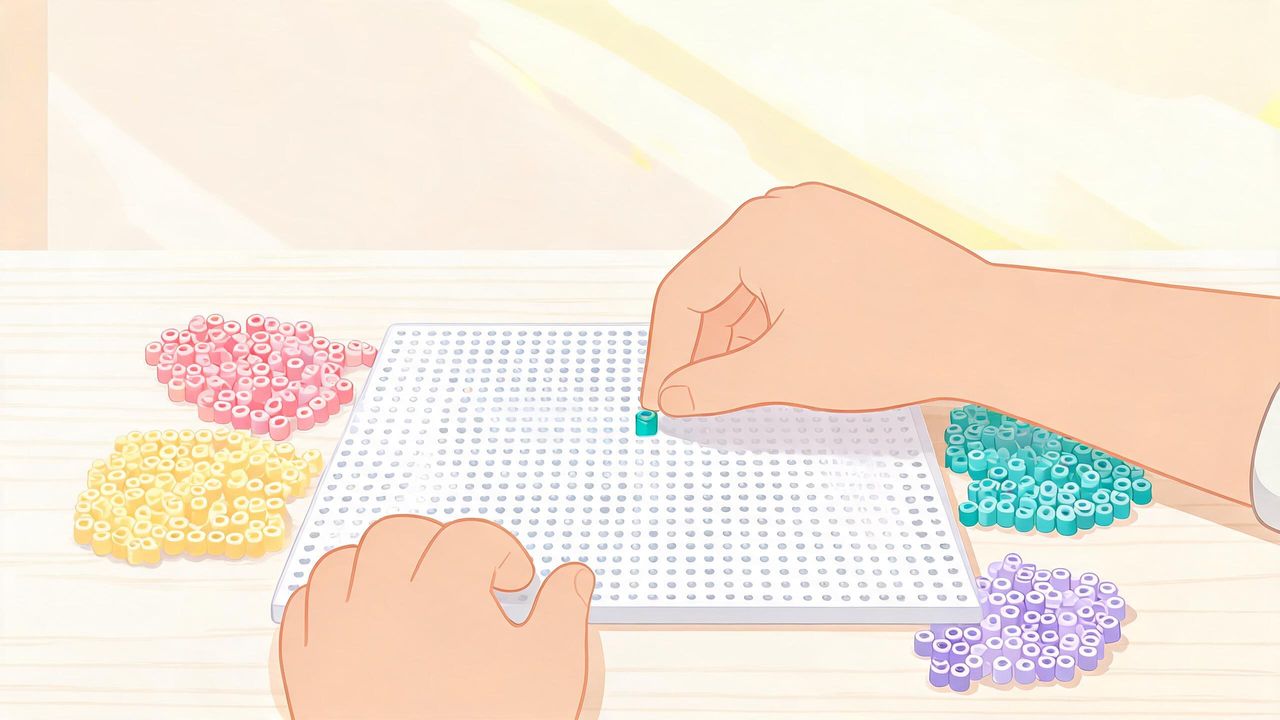
Material: polyethylene, stable at room temperature
Fuse beads are made of polyethylene (PE), the same family of thermoplastics widely used for food packaging. PE is chemically stable at room temperature, odorless, and safe for brief skin contact — which is exactly why it works as a children's craft material. The claim that fuse beads contain BPA is incorrect: BPA is a polycarbonate (PC) issue, and polyethylene production does not use BPA.
Major brands (Perler, Hama, IKEA Pyssla and others) sell into US and EU toy markets and test against toy-safety standards such as EN71 (EU) and ASTM F963 (US). Look for the CE mark or ASTM statement on the packaging; unbranded beads from online marketplaces do not always carry equivalent testing, so for young children prefer brands with an explicit safety declaration.
Note the difference between "material-safe" and "mouth-safe." Non-toxic does not mean the beads belong in a mouth — they are small parts and are not designed for oral contact. The same line applies to ironed finished pieces: they are not teethers and babies should not chew on them.
Ironing: hot work, keep the room ventilated
Ironing is the only genuinely risky step in the whole process. The iron soleplate runs at roughly 150–200 °C; polyethylene softens and turns tacky in this range and gives off a faint odor. The odor comes from a small amount of volatiles — brief exposure is not harmful, but ventilate the room: open a window or run an extractor fan. A mask is not required.
Two hard rules. First, do not hold the iron on the beads too long or re-iron at high heat: overheated beads scorch and discolor, and scorched plastic smells acrid — that is also the second reason to test-iron on spare beads first, because the shortest time that fuses cleanly is both the best result and the safest one. Second, ironing is an adult-only task: the soleplate and the freshly ironed piece are both above 100 °C.
Ironing paper keeps the plastic off the iron. Silicone-coated baking parchment works as a substitute; never use wax paper or cling film, because the wax melts onto both the beads and the soleplate.
- Iron at medium heat, steam off, reservoir empty; roughly 150–200 °C
- Ventilate while ironing; avoid ironing large batches in a closed room
- Acrid smell means scorching — lower the heat and shorten the time
- Iron and fresh pieces stay hot; adults only
Small parts and age recommendations
Fuse beads are 2.6–10 mm across, which makes every size a small part. Under three years old there is a choking hazard — this is the standard toy-industry age line, not something specific to fuse beads. From age three up, Midi 5mm or Maxi 10mm under adult supervision is the common practice; Mini 2.6mm demands fine motor skills and is generally better for school-age children.
Maxi 10mm beads are twice the diameter of Midi, which lowers the ingestion risk, making them the natural toddler size. "Big beads" still does not mean "no supervision" — any granular craft material deserves a watchful adult.
The finished piece's own risk depends on size: a small 14×14 piece is still a small part and should not go to a child who mouth-objects, while larger fused pieces are structurally solid and fine to play with.
Can finished pieces touch food and heat?
An ironed piece is fused polyethylene: it can be washed with water, but it must not hold hot food — PE softens around 80–100 °C, so a fresh hot drink will deform it, and it must never go into an oven, microwave or dishwasher. If you use one as a coaster, remember a just-poured drink can exceed the limit; a cork or metal trivet underneath is safer.
The surface is also not a food-contact surface. Even though polyethylene itself is common in food packaging, an ironed bead piece has a pressed, creased surface that is hard to clean and not intended to touch food. Keychains, ornaments, pixel-art frames and game pieces are all fine.
Frequently asked questions
- Is the smell from ironing fuse beads toxic?
- The odor comes from small amounts of volatiles released as polyethylene heats up. Brief exposure is not harmful, but iron in a ventilated space. If the smell turns acrid, the beads are scorching — lower the temperature, shorten the time, and keep ventilating.
- What age are fuse beads for?
- Not under three (choking hazard); from three up, Midi 5mm or larger beads under adult supervision; Mini 2.6mm is better for school-age children. Whatever the age, the ironing step is adults only.
- Can a fuse-bead piece be used as a coaster?
- Yes, but PE softens around 80–100 °C, so it cannot take a freshly boiled drink and must never go in an oven or microwave. Room-temperature or warm cups are fine; for hot drinks use cork or a metal trivet underneath.
- Do fuse beads contain BPA?
- No. BPA is associated with polycarbonate production; polyethylene, the material of fuse beads, is not made with BPA. Major brands test against EN71 / ASTM F963 — check the certification marks on the package.