How Many Fuse Beads Do You Need? Counting and Estimating
"How many beads should I buy?" is the most practical question before ordering. The answer is computable straight from the pattern: one bead per filled cell, so any pattern's usage is a fixed number — the only extra input is a spare factor. This article walks through three estimation paths and the weight conversion for bulk buying.
Last updated: 2026-11-05
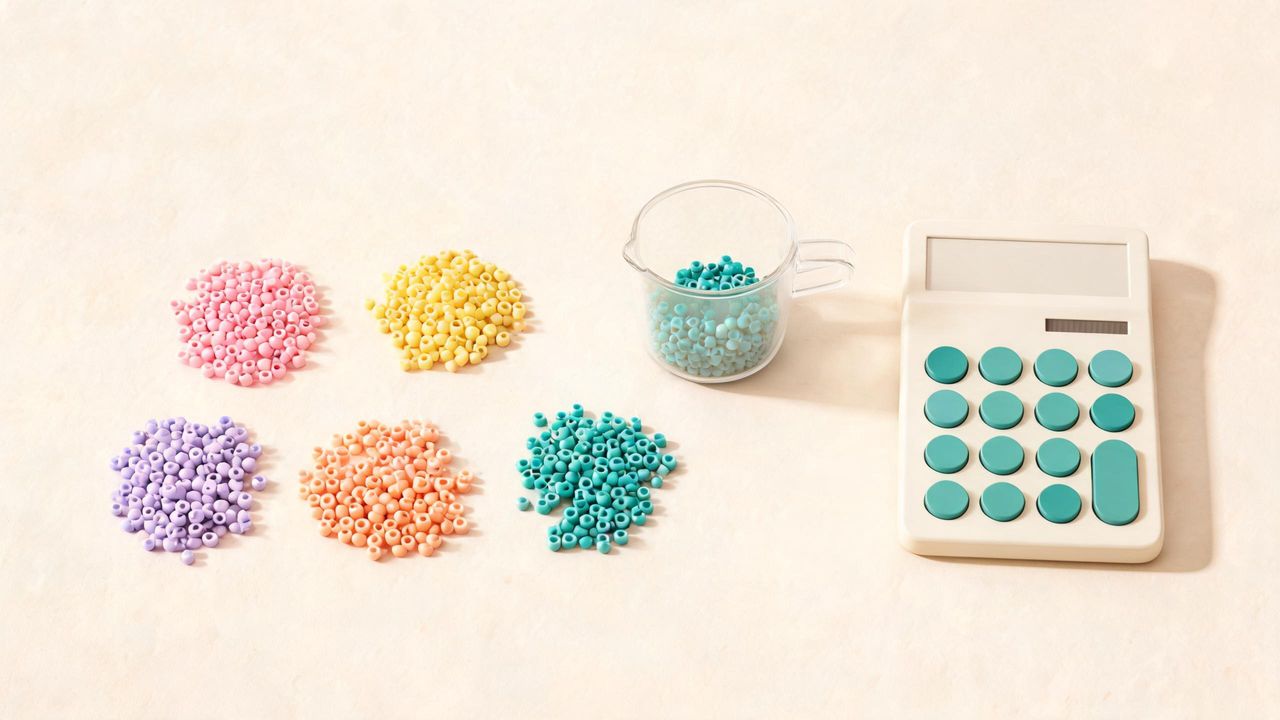
The exact method: count the cells
A bead pattern is a grid where every cell is either empty or one bead, so the exact count is simply the number of filled cells. A full 29×29 board is 841 beads; real patterns are rarely solid — fill rates of 60–80% are typical, which is about 500–700 beads per 29×29 pattern.
Breaking the count down by color is what makes it purchasable. One pattern usually uses 8–20 colors, with a few dominant colors taking more than half and a long tail of colors needed only a handful of times. Every pattern generator outputs a bill of materials (BOM) listing the count per color code — buy against the BOM, then apply the spare factor.
Each pattern page on this site shows the bead count per color, and the downloaded PDF and Excel BOM list them all by code. For multi-board patterns (say a 100×100 image split into 29×29 boards), the total is the filled-cell count of the whole image; the BOM is already merged, so there is nothing to sum across boards.
Estimating by area without a pattern
To stock up in advance, work backwards from area. Finished edge length = columns × bead diameter: at Midi 5mm, 29×29 is a 14.5 cm square holding 841 beads — in other words, a 10 cm × 10 cm Midi piece is about 400 beads. Given a target size and a fill rate, the total follows immediately.
Quick reference at Midi 5mm and 70% fill: a 10×10 keychain is about 70 beads; a 29×29 coaster about 590; a 3×3-board 87×87 poster about 5,300. At the same size, Mini 2.6mm needs (5/2.6)² ≈ 3.7 times as many beads as Midi — large Mini patterns routinely exceed ten thousand beads, so always budget Mini projects separately.
- Full-grid count = columns × rows (29×29 = 841, 14×14 = 196)
- Typical fill rate 60–80%; sparse outline designs may fall below 40%
- Midi 5mm: roughly 400 beads per 100 cm² of finished piece
- Mini 2.6mm needs ≈ 3.7× the beads of Midi at equal area
Spare factor and weight conversion
Buying exactly the BOM still leaves you short: misplaced beads deform and cannot be reused, beads roll away, and some get scorched. The practical rule is to add 5–10% on top of the BOM total; for long-tail colors (single digits in the BOM) keep at least 3–5 extra of each, because topping up a tiny packet costs far more than stocking a few extra.
When buying loose beads by weight, convert counts to grams. A Midi 5mm bead is about 0.09–0.1 g, so 1,000 beads weigh roughly 90–100 g; a Mini 2.6mm bead is about 0.02–0.03 g. Stated pack counts have tolerances, so plan with the middle of the range rather than the top.
A useful sanity check: a 1,000-count Midi bag covers exactly one solid 29×29 pattern (841 beads) with about 19% to spare. If you plan to make a dozen patterns in a row, budget "about 600 beads per pattern", accumulate, and buy once — cheaper than topping up per project.
Frequently asked questions
- How many beads does a 29×29 pattern need?
- 841 beads for a solid grid; real patterns at 60–80% fill need about 500–700. The exact figure is in the pattern's BOM, which lists the count per color code — the total is the sum over all colors.
- How much spare should I keep?
- Add 5–10% on top of the BOM, and at least 3–5 extra of each color that appears only a few times. Deformed misplacements, lost beads and scorching are the main sources of loss.
- How much do 1,000 fuse beads weigh?
- Midi 5mm: roughly 90–100 g (about 0.09–0.1 g each); Mini 2.6mm: roughly 20–30 g. Wall thickness varies slightly by brand, so plan with the middle of the range.
- How do I count beads for a multi-board pattern?
- Use the filled-cell count of the whole image — do not sum boards one by one. Splitting into boards only changes how the beads are physically placed, not how many cells the image has. The BOM is already merged across the full pattern.