What to Do With Finished Perler Beads: Project Ideas From Keychains to Home Decor
An ironed fuse bead piece is a sheet of fused polyethylene: washable, color-stable, drillable and glueable — but it fears high heat and is not a food surface. Around those two limits, this list sorts the common uses into worn, displayed, and gifted, with the practical notes for each.
Last updated: 2026-11-05
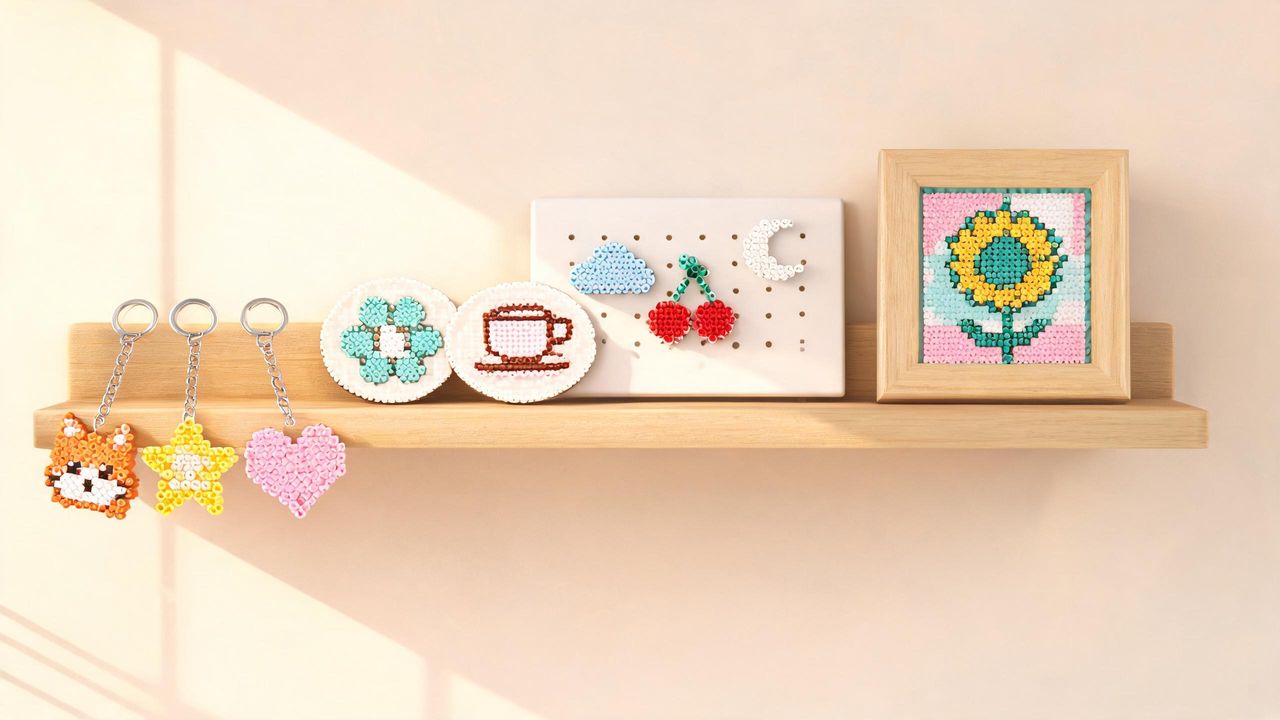
Worn: keychains, charms and pins
Keychains are the classic project. Practical notes: use a 14×14 or 15×15 board (7–7.5 cm finished in Midi 5mm) and a double-sided fuse for strength. Prefer findings that attach through the piece: plan one dark bead at the pattern's edge, and after cooling glue a ring finding onto that bead — the load spreads evenly. Drilling through the finished piece tends to crack it; don't.
Bag charms and hangers work the same way — cord through a metal ring, knotted. For pins, glue a pin back onto a flat-backed single-side fuse with a clean, dust-free bonding face. Adhesive-backed fittings lose grip in the cold, so for long-term wear choose hot glue.
For necklaces or earrings, watch the weight: a solid 29-board piece (841 beads) is far too heavy for earrings. Use 14 boards or designs with open areas to cut the weight.
Displayed: coasters, magnets and desktop pieces
Coasters are the second classic use, with one physical limit to remember: polyethylene softens around 80–100 °C. Room-temperature or warm cups are fine; freshly boiled drinks can deform the piece. Add a cork or metal backing layer, or treat it explicitly as a decorative mat rather than a heat pad.
Fridge magnets take magnet sheets glued to the back with hot glue — the refrigerator door is a cool, safe display spot and the most forgiving place to show pieces off. Desktop pieces (mini stands, game tokens, props) use a double-sided fuse with a base, or several pieces assembled into a panel.
For framing, iron one side only: the un-ironed face keeps each bead's outline and open hole — the strongest pixel look — and the glass in a frame presses and protects it. The gallery patterns on this site (37 community designs, each with its full grid and color codes) can be built straight from their material lists.
Gifted: holidays and events
Holiday ornaments are the highest-frequency scenario: Christmas hangers, Halloween pumpkins, Lunar New Year characters — a dozen 14-board pieces is an afternoon. Plan the hanging point at the design stage (one edge bead for the ring); it beats improvising after the piece is done.
Party favors and event materials suit small batch work: name tags, badges and table numbers within 15 boards. Make one full sample first to confirm colors and looks, then scale the shopping from the exported material list, which includes per-color quantities — multiply per unit.
Run the safety list before giving pieces to children: anything under about 3 cm is still a small part and stays away from toddlers who mouth objects; finished pieces are not teethers and not food-contact surfaces; ironing is always an adult's step.
Frequently asked questions
- Can finished fuse bead pieces be washed?
- Yes. Fused polyethylene pieces are washable and color-stable, but avoid hot water soaks, dishwashers, and alcohol or solvent wipes, which dull or deform the surface.
- Can a fuse bead coaster hold a hot cup?
- Room-temperature or warm cups are fine, but polyethylene softens around 80–100 °C — freshly boiled drinks can deform the piece, and ovens, microwaves and dishwashers are out. Add a cork or metal layer for hot drinks.
- What is the strongest way to attach a keyring?
- Attach through the piece: plan one bead at the pattern's edge and, after cooling, glue a ring finding onto that bead with hot glue so the load spreads evenly. Drilling the finished piece tends to crack it, and adhesive pads pull off over time.
- Can I put a fuse bead piece in a picture frame?
- Yes, and it is recommended with a single-side fuse: the un-ironed face keeps the bead outlines and open holes for the strongest pixel look, and the frame glass presses and protects it. Avoid hot display spots such as sunlit windowsills.
- What patterns work best for charms?
- Bold outlines and few colors (12–16) on a 14 board: 7 cm finished wears well and stays light. A solid 29-board piece at 841 beads is too heavy for earrings, though fine for bag charms.