How to Connect Pegboards for Large Fuse Bead Patterns
One standard large board is 29×29 — a 14.5 cm finished piece. Anything bigger means connecting boards. Building a board array is easy; the real work is choosing the right board size and understanding the splitting rule: a bead cannot sit across two boards, so the pattern must be cut along board boundaries. This article explains sizes, assembly and the splitting logic.
Last updated: 2026-11-05
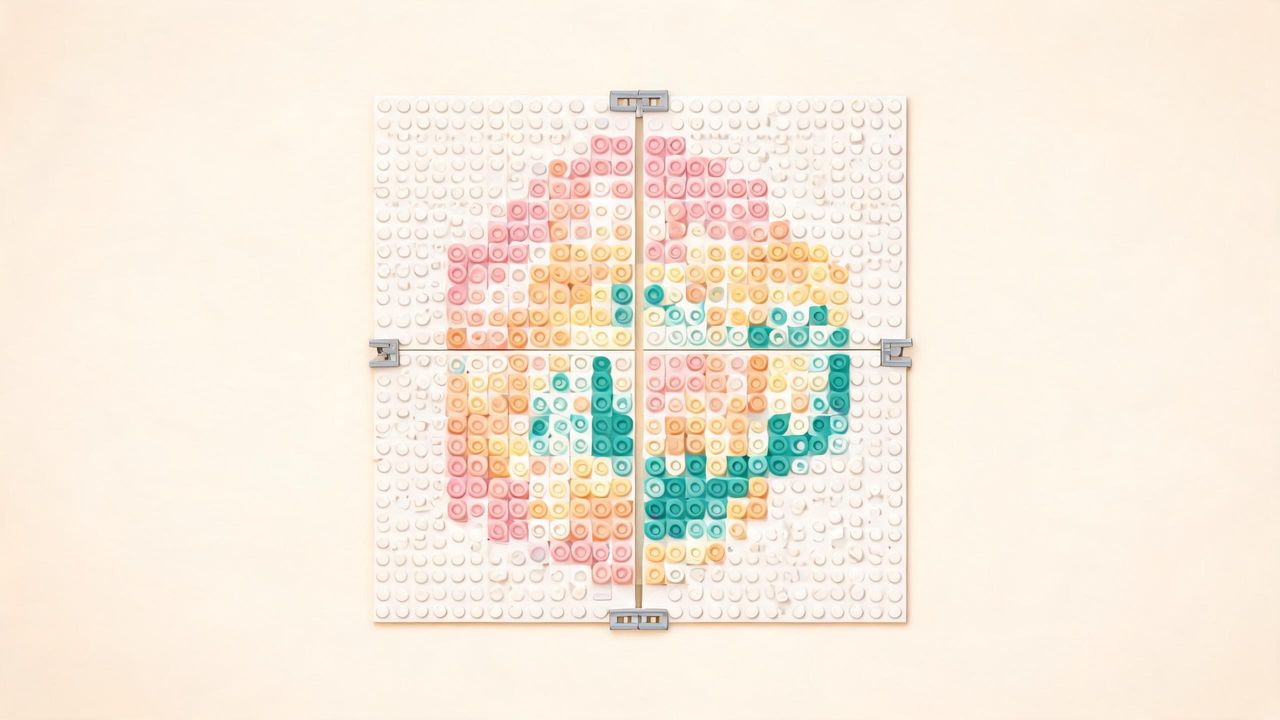
Common board sizes and finished dimensions
Pegboards come in a few standard sizes: 14×14 small boards (7 cm finished in Midi 5mm), the 29×29 standard large board (14.5 cm finished — the most common "one board, one pattern" size), and 56×56 / 57×57 super boards (about 28–28.5 cm finished). The 56 vs 57 difference is historical: 56 is an exact 4×4 multiple of the 14-board, while 57 is a common standalone large-board size.
One formula converts everything: edge length = cell count × bead diameter. At Midi 5mm, 29 cells = 14.5 cm. To hit a target size, divide the target edge by the bead diameter for the cell count, then divide by one board's cells for the array size.
The same pattern can be made on different board sizes: the design is identical, only the physical size changes — a 29×29 pattern is 14.5 cm on Midi 5mm and 29 cm on a Maxi 10mm board. Whichever board size you pick when downloading, the exported board pages are cut to match.
- 14×14 board: 7 cm finished in Midi — keychain and charm size
- 29×29 board: 14.5 cm finished in Midi, 841 beads solid
- 56×56 / 57×57 boards: about 28 cm finished — a 4×4 small-board array
- Edge length = cells × bead diameter; that is the whole conversion
Building a large array from small boards
Most brands' boards have interlocking tabs and slots, so they clip into any array: a 3×3 array of 29-boards is 87×87 cells — 43.5 cm finished. Two practical points: use boards from a single brand within one project, because peg pitch varies slightly between brands and mixing causes seam misalignment; and build the array on a rigid surface, since a soft table lets the whole array bow.
Why beads must not cross a seam: every bead needs to sit fully on one board's pegs to heat and set evenly. A bead bridging two boards has nothing under its middle, and after ironing the seam shows a weak spot that can crack. That is why large images are cut into whole boards: place each board's beads separately, then iron per board or as a whole array.
You can iron a large array two ways: iron the whole array in one pass (continuous color across seams, but you need enough iron area to sweep the entire array), or iron each board separately and assemble afterwards (more controllable, better for very large pieces — the seam is barely visible from the back).
How downloads split a pattern by board
When you download a pattern from this site, it is cut by the board size you pick: an 87×87 image becomes 3×3 = 9 boards at 29, or 7×7 = 49 boards at 14 (edge boards that are not full still export with their actual cells). The rule is that cells never straddle boards — the same physical constraint as above.
In the exported PDF / image pack, page one is the overview with board numbers (board 1, board 2, …), then one page per board: that board's grid plus its own material list. Place beads board by board following the numbers, assemble by the overview — a big poster becomes "repeat one small task 9 times" instead of "place 8,400 beads at once".
Empty boards are skipped automatically: if a board position in the array holds no beads at all (the corners of a circular design, for example), that board simply does not appear in the list — nothing to place, nothing to iron.
Frequently asked questions
- Will a large piece assembled from small boards break at the seams?
- Not if no bead crosses a seam — every bead sits fully on its own board's pegs, and the ironed piece is one solid sheet. Beads bridging two boards are what cause cracks, which is exactly why patterns are split by board boundaries first.
- How many 29-boards does an 87×87 pattern need?
- 3×3 = 9 boards, a 43.5 cm square finished. Solid 87×87 is 7,569 beads; at a 60–80% fill rate, budget roughly 4,500–6,000.
- Can I mix pegboards from different brands?
- Not within one array. Mainstream Midi boards share the 5mm pitch and clip together physically, but tab positions and tolerances differ, and mixing causes seam misalignment. One brand, one batch, is the safe choice.
- What if a pattern's edge does not fill a whole board?
- Edge boards export with their actual cells only — blank columns and rows are trimmed. Completely empty boards (the corners of circles or hearts) are skipped, so the real board count can be lower than the array's theoretical total.