Perler Beads for Kids: Age Guide and How to Craft Together
Fuse beads are one of the rare crafts that scale with a child just by changing bead diameter — the same activity works from preschool through elementary school. Two rules do most of the work: pick the bead size by age, and the ironing stays with an adult. Here is the age-by-age plan plus concrete steps for crafting together.
Last updated: 2026-11-05
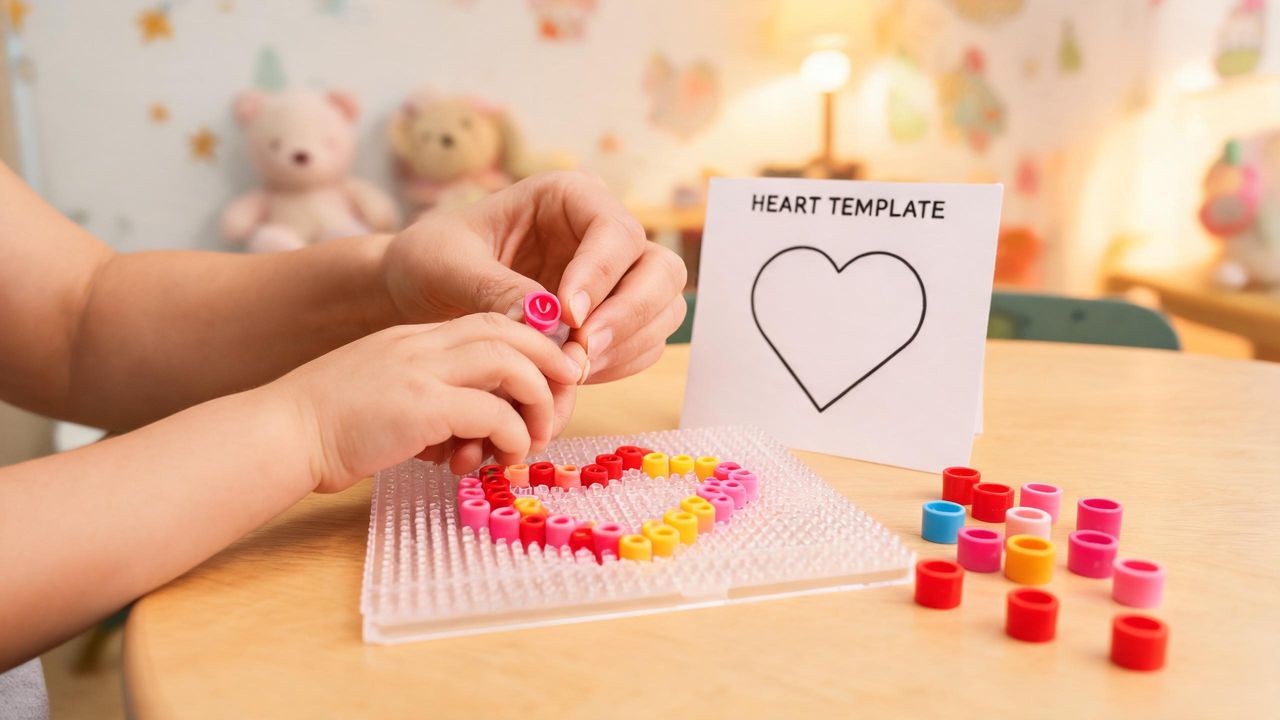
Ages and sizes: match the bead to the age
Under 3: skip it. Every fuse bead size is a small part with a choking hazard — this is the standard toy-industry age line. If beads are in the house, store them out of reach.
Ages 3–5: Maxi 10mm. Twice the diameter of Midi, easy to grip and far lower ingestion risk. A small pile is enough — placing one bead at a time is itself fine-motor practice. Supervision throughout.
Ages 6–8: Midi 5mm. Fine motor control is ready for independent placement, starting from template cards or simple 14×14 patterns; ironing stays with an adult. Save Mini 2.6mm for school age and up — it demands fingertip strength and patience, an advanced tier rather than a starting point.
Crafting together: a four-step routine
Step 1 — start at 14×14: a 14×14 pattern takes ten to twenty minutes, so the child sees the full loop from placing to fused piece; that completed feeling is what keeps them playing. Save 29×29 for later.
Step 2 — sort colors into piles: pour the needed colors into a small tray or bowls before placing. No digging through a tub, and color recognition happens naturally — finding the matching color is the exercise.
Step 3 — the adult places the first row: fill the bottom (or left) row yourself and let the child continue from row two. The boundary is instantly established and rows stay straight; symmetric designs (hearts, snowflakes) split naturally into one half each.
Step 4 — the ironing moment: the adult fuses the finished board through paper while the child watches loose beads turn into one solid sheet — the most magical three seconds of the craft, and double-side fusing makes hanging pieces more durable.
Handling common situations
A bumped-over section: no restart needed. Beads aren't fused, so just place them back following the pattern — reworkability is exactly why fuse beads are toddler-friendly, unlike sticker crafts. If bumps happen often, use boards with a raised border frame, or split the work into small sessions and areas.
A bead in the mouth: stop immediately and check the mouth; then switch to Maxi 10mm and keep supervising. For children under three, stop contact with any bead size entirely.
Ran out of a color: refill from the pattern's shopping list (exports include per-color counts) instead of buying a new mixed pack for one missing color.
What to do with finished pieces: turn them into magnets (adhesive magnetic strip), keychains (split-ring findings) or hangings (thread through a hole) — using the artwork is the strongest positive feedback loop.
Frequently asked questions
- What age can kids start fuse beads?
- Not under 3 (small-parts choking risk); ages 3–5 play with Maxi 10mm supervised; 6+ can place Midi 5mm independently; Mini 2.6mm from school age. Ironing is an adult's job at every age.
- How big should a first pattern be?
- 14×14. It finishes in ten to twenty minutes — a complete loop from placing to fused piece. A full 29×29 (up to 841 beads) is too long for young children's patience.
- What do kids actually learn from fuse beads?
- Placing bead-by-bead against a pattern trains hand-eye coordination and fine motor skills; sorting colors builds color recognition; reading a pixel grid as a picture trains spatial thinking — which is why the craft is popular in classrooms.
- Can a child do the ironing?
- No. The soleplate and the freshly fused piece are both above 100 °C — ironing is adult-only, with the child watching from a safe distance.
- What if a child swallows a bead?
- Check the mouth immediately; treat coughing or breathing difficulty as a foreign-body airway emergency and seek medical help. Polyethylene itself is non-toxic — the risk is airway blockage, not poisoning. Afterwards switch to Maxi 10mm and tighten supervision.