Perler Beads vs Diamond Painting: Materials, Process and How to Choose
Perler beads and diamond painting look alike — both fill a grid with small pieces by symbol — but their fixing principles are opposites: beads are placed first and fused last, so everything is reworkable; drills stick the instant they land, so placement is final. Once you see that, the right use cases for each become obvious.
Last updated: 2026-11-05
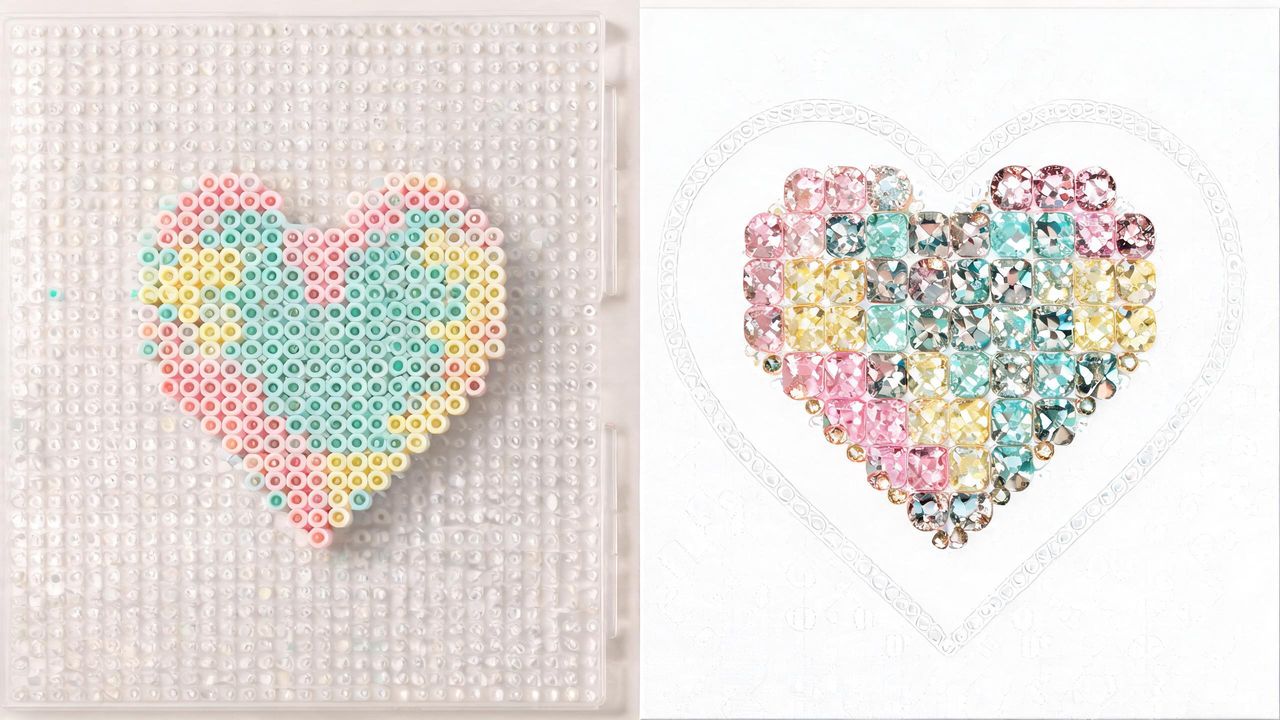
Materials and fixing: place-then-fuse vs stick-on-contact
Fuse beads are polyethylene (Midi 5mm is the common size), placed on a pegboard with raised pegs and fused at the end with an iron through paper. Fixing happens last; every step before it is editable.
Diamond painting uses faceted resin drills on a pre-glued, symbol-printed canvas: peel a corner of the protective film, pick drills up with a stylus pen, and press them onto their symbols. The adhesive fixes them immediately — a misplaced drill can be removed with heat or tools but it is difficult, so in practice a placed drill is final.
That is why the cost of mistakes differs so much: beads allow unlimited trial, recoloring and redesign at the board; diamond painting front-loads the checking (read the symbols correctly) and leaves no way back after placement.
Process: needs an iron vs click-and-decompress
The fuse bead flow is convert a pattern → place beads by board → iron. Tools: pegboard, iron, ironing paper, and the ironing step is an adult's job. Patterns come from your own drawing, photo conversion, or ready-made designs; large images are split by board size.
The diamond painting flow is unroll the canvas → peel → place drills, with a stylus and tray as the only tools. No heat source, a lower barrier to start, and a meditative repetitive motion — but the image is fixed by the kit; you cannot design your own.
Custom freedom is the fuse bead advantage: any photo can become a pattern (this site supports 14–57 board sizes and 12–32 color counts), and materials are bought to match the pattern. Diamond painting is kit-bound by design.
Finish and durability
A fused bead piece is a solid plastic sheet with a strong pixel look (the un-ironed face keeps each bead's outline and open hole). It can become keychains, coasters and magnets — handled objects — but fears heat (polyethylene softens around 80–100 °C). Single-side fuses pull apart more easily; double-side fuses are stronger but lose pixel definition.
A diamond painting is a sparkling surface for framing and wall display. Durability depends on the adhesive layer: over time and humidity, individual drills can lift off and need re-gluing with spares. It is a pure decoration piece — not suitable for stress-bearing uses like keychains.
Color systems differ too: fuse bead brands use their own codes (988 deduplicated codes across the 9 palettes indexed on this site), needing mapping between brands; diamond painting universally uses the DMC embroidery-thread code system, so codes mean the same thing in every kit.
How to choose, by scenario
Choose fuse beads if you want to design your own patterns (photo conversion), rework and rebuild, make handled objects (charms, coasters), or craft with children (3+ supervised, ironing by an adult).
Choose diamond painting if you want a sparkling framed decoration, enjoy meditative repetitive placement, have no need for custom images, and want zero heat involved.
Cross stitch sits outside the pair: thread on grid fabric, slower, washable, frameable — and its DMC color system is exactly what diamond painting adopted. Sort the three by three questions: custom image or not, heat source acceptable or not, playable or purely decorative.
Frequently asked questions
- Which is better for kids, fuse beads or diamond painting?
- Fuse beads suit ages 3+ with supervision (mini 2.6mm beads from school age; ironing by an adult). Diamond painting drills are even smaller — the same swallowing risk — and the fixed adhesive offers less creative freedom than reworkable beads.
- Which is cheaper, fuse beads or diamond painting?
- Both start cheap. The difference is sourcing: beads can be bought per-pattern from the material list (codes searchable by brand) and one stock serves many patterns; diamond painting is kit-based with full materials per design, which adds up if you make many.
- Which finished piece lasts longer?
- Each has a weak point: a fused bead piece is one solid plastic sheet, waterproof but heat-sensitive; diamond painting adhesive ages with time and humidity and drills can lift off, needing spares. For handled items choose beads; for wall decoration either works.
- Can I make a diamond painting from my own photo?
- Not with standard kits, which ship fixed designs only. To turn a photo into a hand-made pixel piece, use fuse beads: a converter turns the image into a coded pattern, split by board size for export.
- Can fuse beads and diamond painting be mixed?
- Not as materials: plastic beads need a pegboard and heat, resin drills need an adhesive canvas — the processes are incompatible. But finished works display well side by side: one pixel look, one sparkling face.