Perler vs Hama vs Artkal: Fuse Bead Brands Compared
Perler, Hama and Artkal stand for the North American, European and Chinese supply chains of the same hobby. Their 5mm Midi beads share one pitch and work interchangeably; what actually differs is palette size, bead hardness and where you can buy them. This article compares them for real purchase decisions and explains how to convert color codes when using cross-brand patterns.
Last updated: 2026-11-05
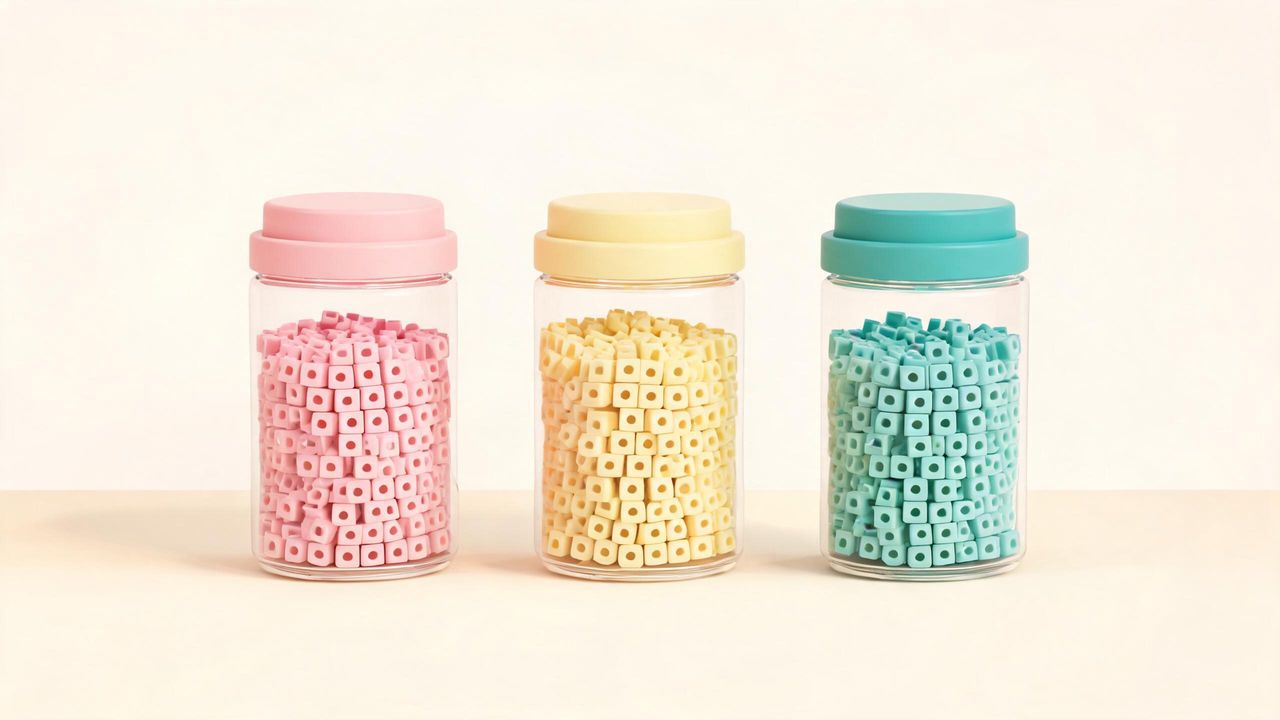
Sizes: Midi 5mm is the universal mainstream
Every brand splits its line by diameter: Midi 5mm is the dominant standard behind most patterns and pegboards; Mini 2.6mm serves detailed pixel art (≈3.7× the bead count per area); Maxi 10mm is the toddler size. The first rule of buying: pattern, board and beads must match — a 5mm pattern needs 5mm boards and beads.
Patterns on this site are designed for Midi 5mm by default; when downloading you can map the material list onto any of 9 brand palettes (Perler, Hama, Artkal hard/soft, MARD, Nabbi, IKEA Pyssla and others) or a 48-color universal card. Switching palettes never changes the design — only the color codes listed in the BOM.
- Midi 5mm: universal mainstream with the richest pattern/board ecosystem
- Mini 2.6mm: detailed pixel art, ≈3.7× beads per area
- Maxi 10mm: toddler-safe, chunky results
- Pattern, board and beads must all be the same size
Palette size and bead hardness: where they differ
Palette size is the most visible gap: Perler Midi has about 117 colors, Hama Midi about 89, Artkal's hard-bead line about 176, and the Chinese MARD Mini 2.6mm line reaches 221. More colors means smoother gradients — skin tones and sky transitions are exactly where a small palette forces visible "color jumps".
Bead hardness changes the ironing feel and the result: Perler and Hama are softer and fuse at lower temperature, giving rounder surfaces with smaller holes; Artkal's hard beads need a bit more heat and time but produce flatter pieces with crisp, even holes and better detail — with less tolerance for temperature mistakes. Soft beads are friendlier for beginners; hard beads have the higher ceiling.
Special-effect beads (glow, translucent, glitter) exist in all three brands, and their codes are never shared — buy effect beads by effect, not by brand loyalty.
Availability and picking by scenario
Channel decides access: Perler is everywhere in North American retail; Hama dominates Europe; Artkal and MARD are fully stocked on Chinese marketplaces and ship internationally. IKEA Pyssla has only 18 colors but is cheap and available in stores — a fine entry point; Nabbi (about 30 colors) is common in European educational settings.
A simple scenario rule: toddlers get Maxi; casual beginners get whatever 5mm is cheapest locally (including Pyssla); serious pattern makers benefit from the bigger palettes (Artkal hard / Perler); detailed Mini pixel art points to MARD / Artkal Mini.
Cross-brand patterns: converting color codes
The three brands' color codes are not compatible: a Perler code has no meaning on the Artkal card. When you use someone else's pattern, convert the BOM's codes to the brand you actually own. The manual way is eyeballing the closest match across two cards; the reliable way is an automated nearest-color mapping using perceptual color distance (weighted RGB / CIE).
On this site, picking your brand when downloading remaps the material list automatically: exact matches keep the plain code, approximate ones get an "≈" prefix with a notice in the BOM. The pattern itself is always rendered in the original colors — the code mapping only affects which physical bead you buy.
Mixing brands within one pattern works physically (same 5mm pitch), but keep each color within one brand: the "same" named color varies between brands, and mixing shows up as blotches in the finished piece.
Frequently asked questions
- Can Perler, Hama and Artkal beads be mixed?
- Yes — all three Midi lines are 5mm in diameter and pitch, and boards and beads are physically interchangeable. But keep each color within one brand: the same named color differs slightly across brands, and mixing shows as blotches.
- Which brand has the most colors?
- Among palettes indexed on this site: MARD Mini 2.6mm with about 221 colors, Artkal hard Midi about 176, Perler Midi about 117, Hama Midi about 89. More colors means finer gradients.
- Which brand should a beginner buy?
- Whichever 5mm Midi is cheapest and easiest to get locally — Perler in North America, Hama/Pyssla in Europe, Artkal/MARD on Chinese marketplaces. Matching the spec matters more than the brand; palette size barely matters at entry level.
- I have an Artkal-coded pattern but Perler beads — what about the codes?
- You need a color-code mapping: manually, compare the two brand cards for the closest colors; on this site, just pick your brand when downloading and the BOM remaps automatically, marking approximations with an "≈" prefix.